Researchers have published hundreds of thousands of prompting techniques. You know maybe five. Our source reads that flood at a scale no person can and keeps what earns keeping; we index that part, 6,235, every one lifted from a published paper you can open and check.
Then we throw almost all of them away. For your task: 150 close candidates, 10 read in full by separate AI specialists, 3 ranked against each other by a judge that shows its reasoning. You pick the winner and it lands as a prompt you can paste. One method out of six thousand, chosen for the job in front of you.
Free to join, no card · your first full run is on us · we checked 1,420 of these effects against the papers that reported them.
MEASURED PERFORMANCE
You've seen it happen. The same model that writes brilliant analysis for a colleague gives you a wall of generic filler.
The difference is not the model. It's the technique. Hundreds of papers have measured which prompting patterns work for which kind of task.
Nobody has time to read them. So most people recycle the same three habits and accept whatever comes back.
Every shallow answer costs you twice: once when you read it, and again when you make a decision based on it.
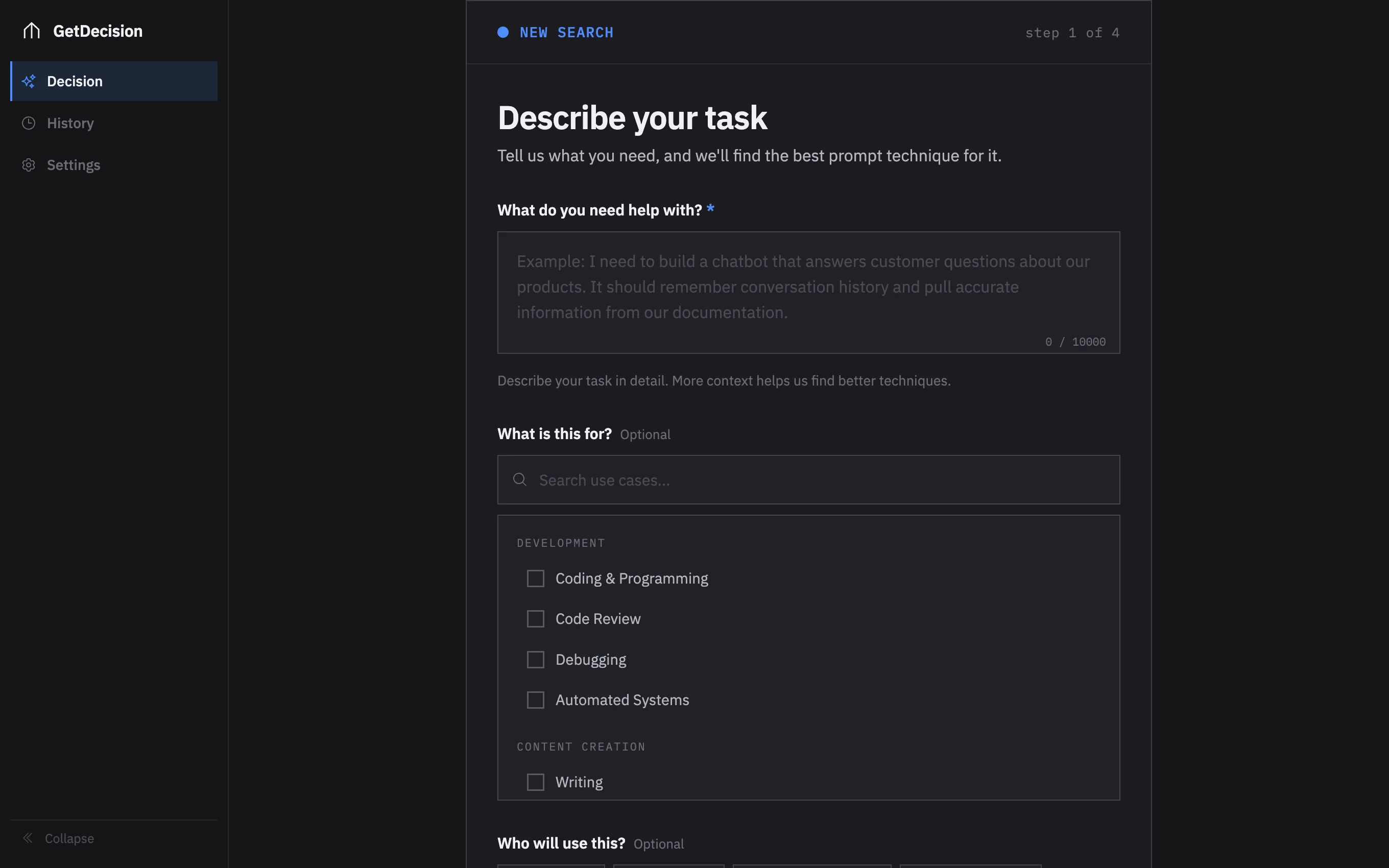
Plain language, any of 97 languages. Attach up to 10 files: PDF, Word, Excel, images.
Your intent gets translated into the vocabulary of the research literature, then matched against 6,235 techniques. Near-duplicates get pushed apart, so the shortlist holds ten different ideas instead of the same idea ten times.
Each finalist gets its own agent: one technique, the full source document behind it, about 5,000 words. No skimming, no summary-of-a-summary.
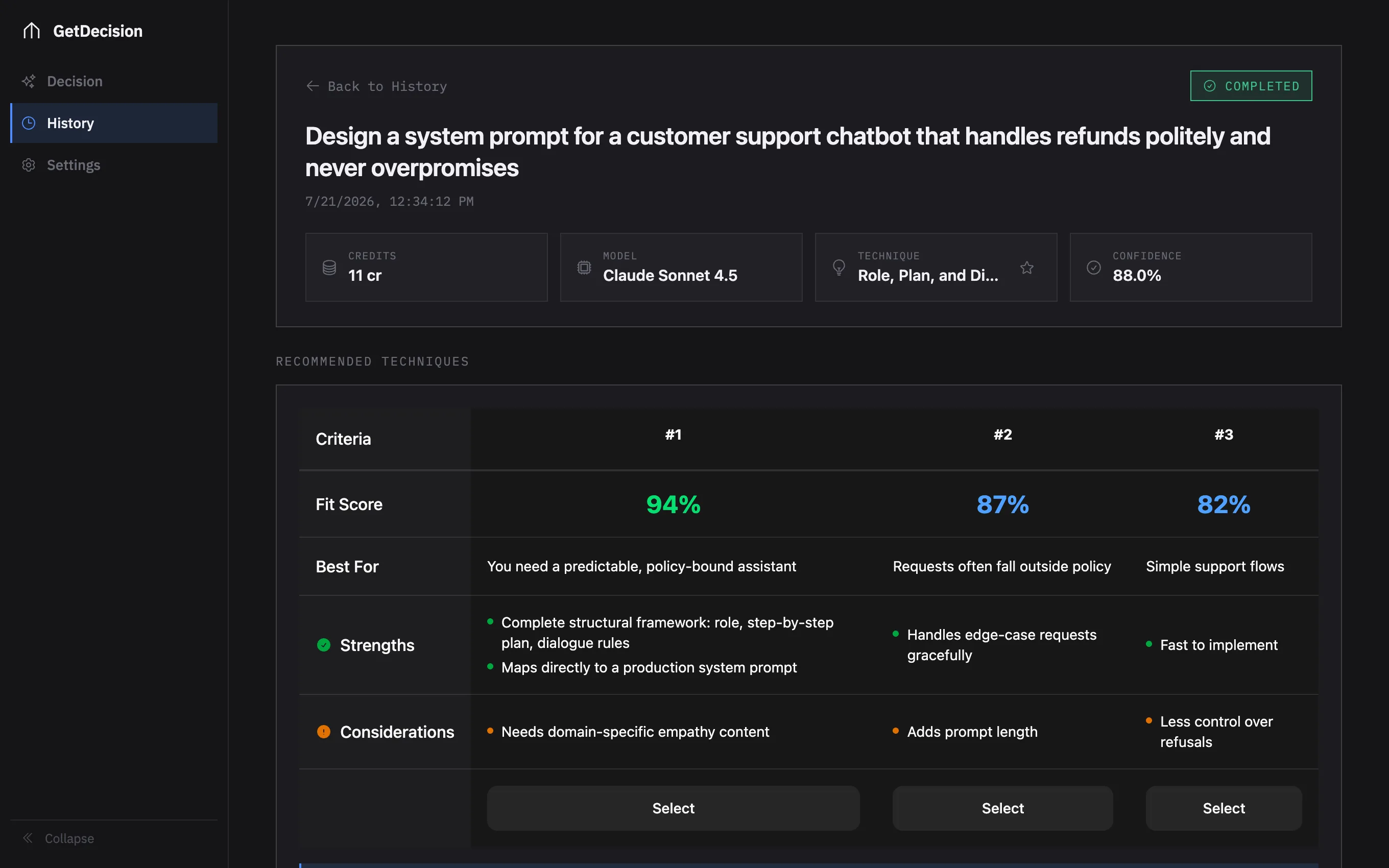
A reasoning model with a 15,000-token thinking budget compares all ten reports and ranks the top three: strengths, weaknesses, when to avoid. You pick. It never picks for you.
A complete prompt that applies the chosen technique to your task, generated on whichever of 7 models you choose. No blanks to fill in.
Real screens from the live app. No mockups.
Fig.Three techniques ranked by fit score, with strengths and considerations. You pick, it never picks for you.
Plain language in, any of 97 languages. Files welcome.
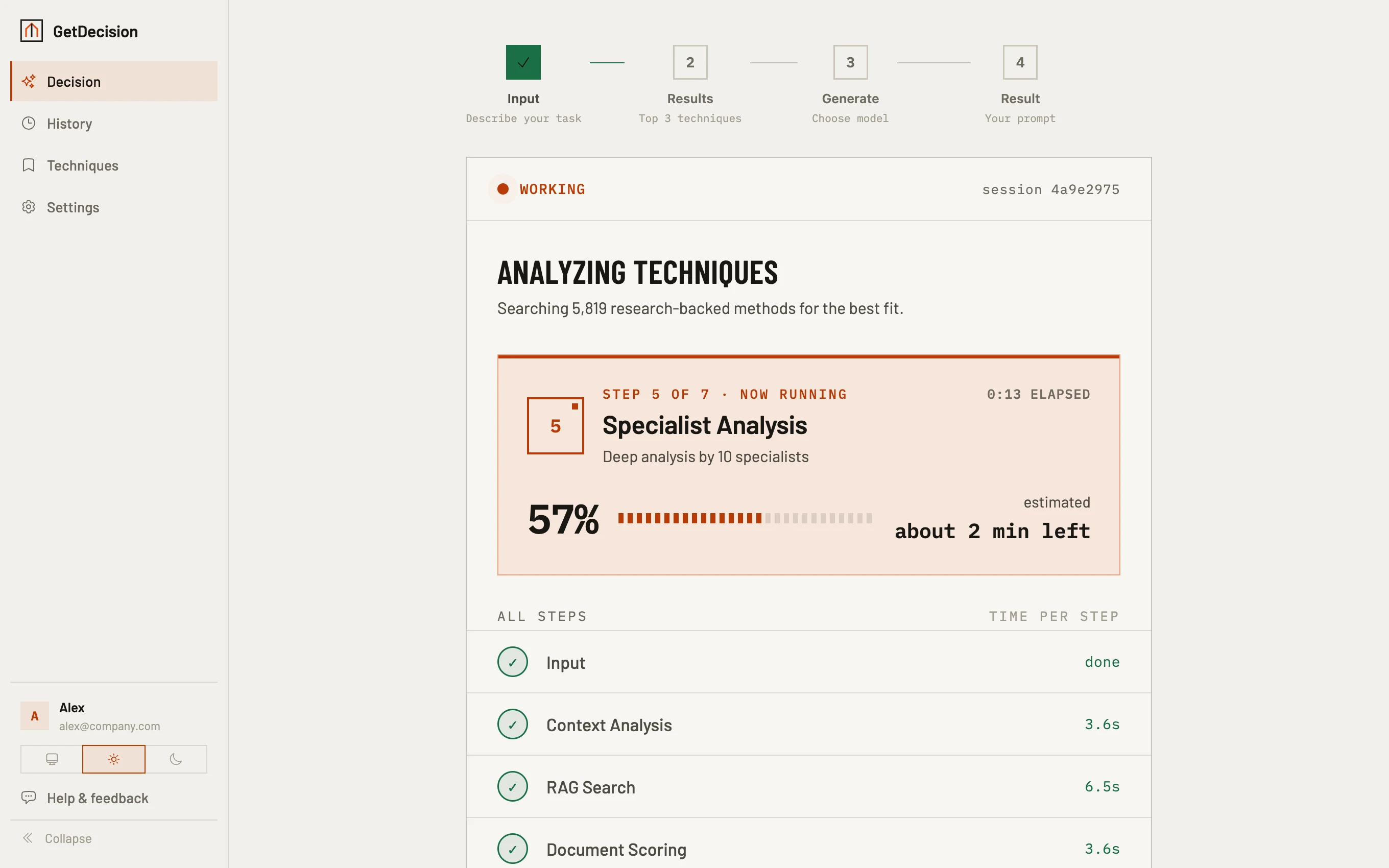
Every stage streamed live while the ten specialists and the judge work.
Every search produces a full trace: seven pipeline stages, per-stage inputs and outputs, and token counts. A live diagram shows candidates flowing from 6,235 down to your top 3.
If a recommendation looks off, open the trace and see where the reasoning went.
Every search, choice, and generated prompt saved and searchable.
Organize techniques by project. Drag and drop.
Your uploaded documents shape both the search and the final prompt.
7 models across budget, standard, and premium tiers.
Rebuild your prompt with any other technique from your Top-3 and compare side by side.
A full run = one search (20 credits) plus one prompt generation (1–12 credits depending on the model).
No. Libraries give you 10,000 prompts and leave the choosing to you, which is the hard part. GetDecision does the choosing, with evidence, and then writes the prompt.
Ten agents are reading full research documents and a judge is comparing their reports. You watch every stage live while it runs.
Gemini 2.5 Flash-Lite runs scoring and the ten specialists, Claude Sonnet 4.5 with extended thinking is the judge. For the final prompt you pick from 7 models: GPT-5.6 Sol, Claude Opus 4.8, Claude Sonnet 5, Gemini 3.1 Pro, Grok 4.5, and two budget options.
Your first run is free, the search and the prompt both. After that, plans start at $10 a month. A search costs 20 credits, generating the prompt adds 1–12 depending on the model. Cancel anytime.
From published AI research. Each technique keeps its source reference, and the full extracted document travels with it through the pipeline.
Describe your task. Watch 6,235 techniques become 3. Take the prompt.
Launch App